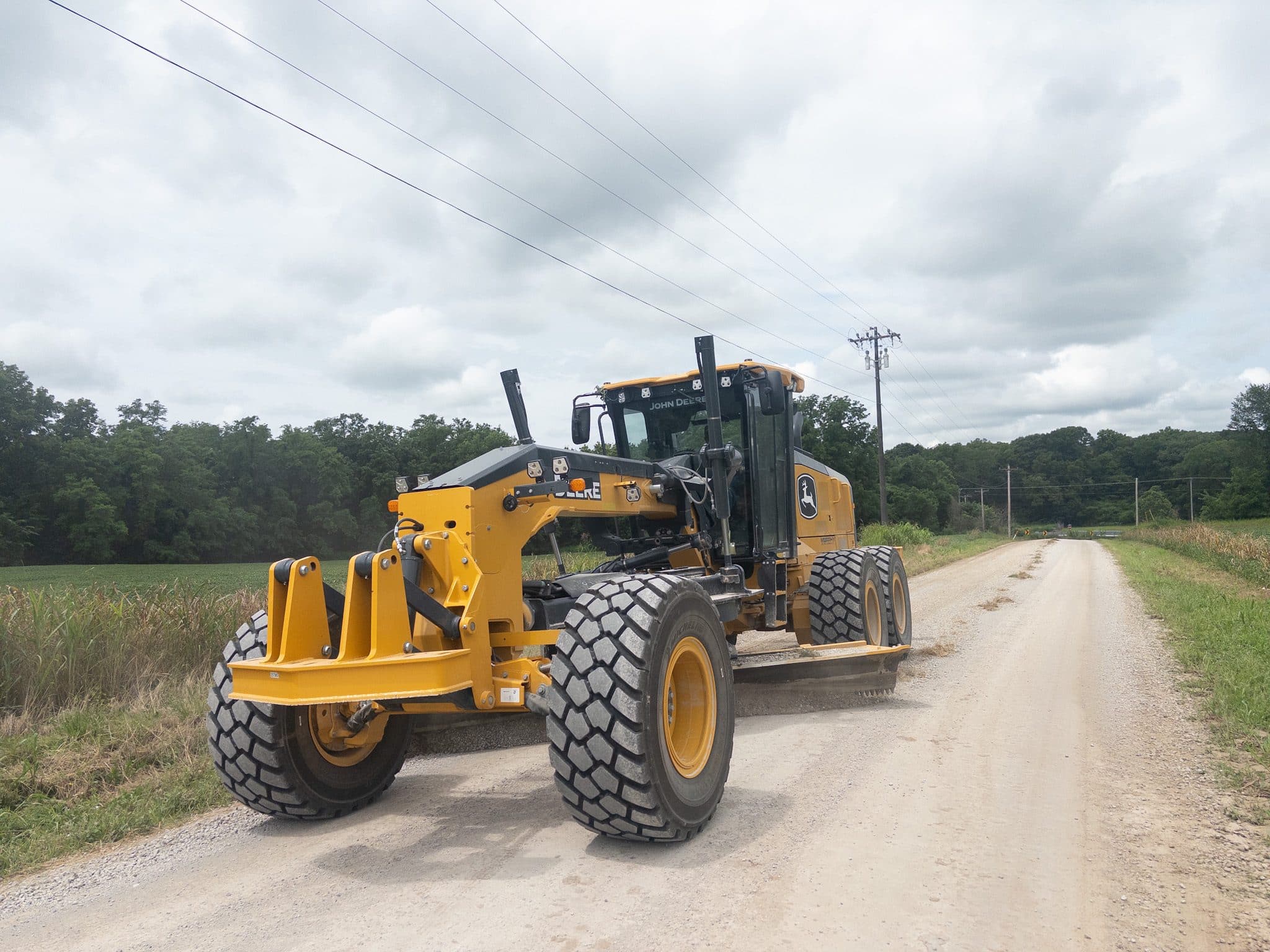
Pyles is responsible primarily for the district’s gravel roads, grading them whenever weather and traffic leave the surfaces rough. He also installs drainage pipes, fills potholes, clears storm debris and helps keep roads open during snowstorms and floods.
“It helps keep them in shape,” Pyles said after demonstrating how he blades a road. “Get up and down them.”
The work is part skill, part instinct and part experience accumulated across nearly four decades.
Pyles learned to operate a grader from his father, who performed similar road work in Buchanan County. When the Weston district needed help, Pyles came south and went to work.
He has remained ever since.
During that time, Pyles has watched equipment change from machines without enclosed cabs or reliable heat to a new John Deere grader equipped with air conditioning, electronic controls and a display resembling a tablet.
“When I first started, I didn’t have air conditioning,” he said.
His earliest equipment did not even have a fully enclosed cab. Asked how operators stayed warm while clearing snow, Pyles offered a characteristically brief answer.
“You’re tough,” he said. “A lot of clothes.”
The district recently replaced Pyles’ older grader with a technologically advanced model. It is the third grader he has operated long enough to wear out during his tenure.
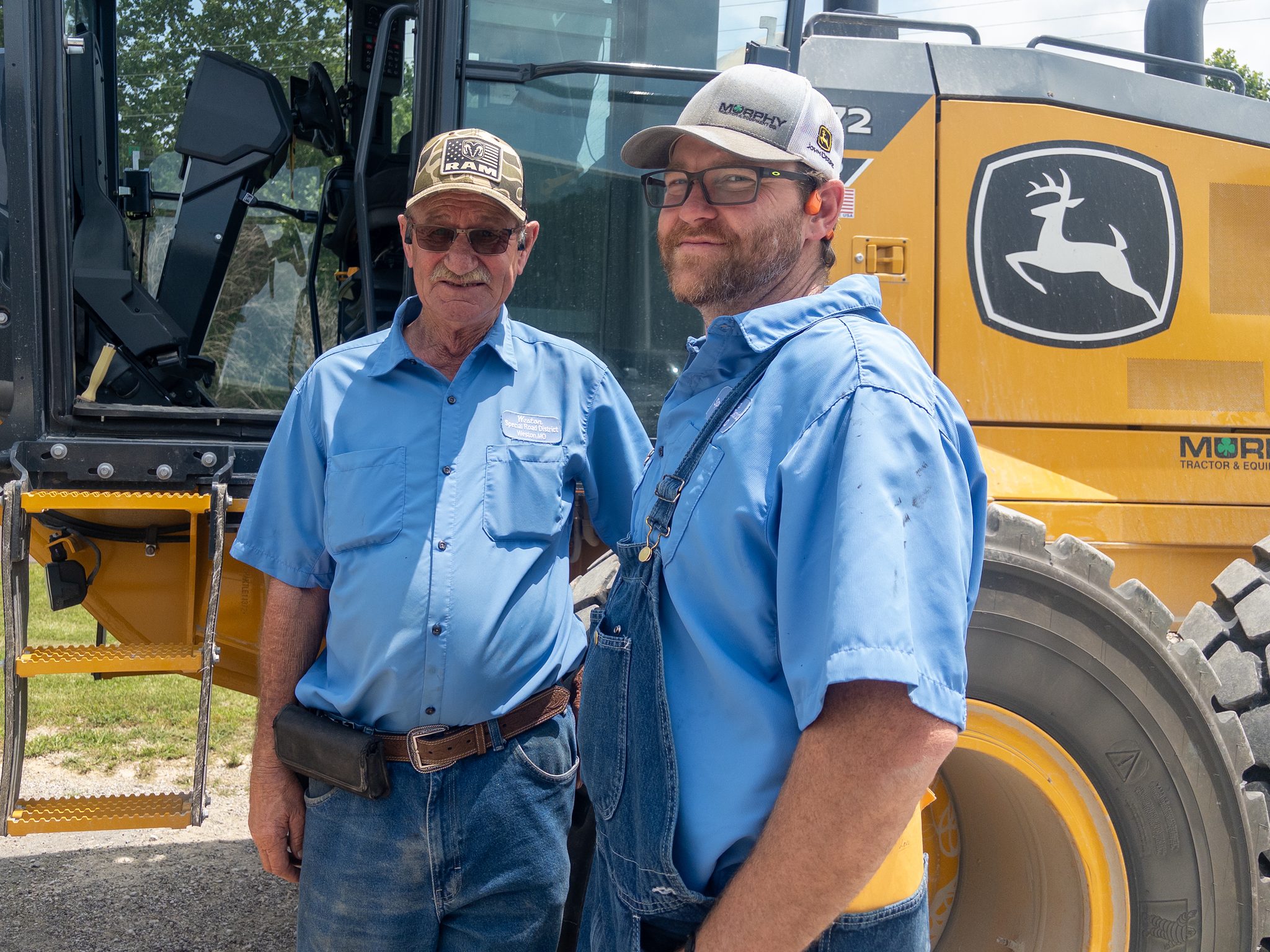
The new controls looked intimidating at first, but Pyles adapted after a few days. Billy Schenkner, supervisor of the Weston Special Road District, said the newer machine also reduces the physical strain of spending long hours adjusting traditional levers to follow the changing contour of a road.
Those hours can become especially long during severe weather.
Pyles recalled spending about 36 hours at a time inside a grader during a major snowstorm. With only three full-time employees maintaining more than 120 miles of roads, stopping before the work is finished is not always an option.
“Because you have to,” Pyles said. “You’ve got to keep the roads open, and there are just three of us here.”
During a large snowfall, two graders may work side by side, each traveling in an opposite lane. The operators communicate by radio as they make repeated passes to move snow beyond the roadway.
One pass across the district can take more than 30 continuous hours, Shenkner said. Completing additional roads in the agricultural bottoms could extend the work to approximately 45 hours.
The work may begin again almost immediately if wind blows snow back across the roads.
“You just keep it going,” Pyles said.
He passes the hours listening to the radio and drinking black coffee. After enough time behind the controls, he joked, the grader can feel as though it is beginning to drive itself.
Snow is only one of the weather-related challenges.
When the Missouri River floods, Pyles may work seven days a week, sometimes 14 to 16 hours a day, removing deposited sand and repairing holes left behind by the water. When severe wind knocks trees across roads, the employees may be called back to work in the middle of the night or on a weekend.
Pyles and the other employees remain on call around the clock.
During one windstorm, the crew reported to the district building after the power had gone out. They opened the garage, fueled the equipment with the help of a generator and spent several hours clearing trees from roads.
“As long as you can get here and get home,” Pyles said, that is the main concern.
The district’s small crew maintains gravel and chip-seal roads stretching from near Hackberry Lane to approximately a mile south of the Amelia Earhart Memorial Bridge near Atchison, Kansas. The district does not maintain streets within the city of Weston, and some state and county roads cross through its service area.
For residents, however, a road is often simply a road. Shenkner said people may not know which government entity is responsible for a particular stretch or understand how much territory the three-person crew must cover.
“A lot of people don’t understand how much it takes,” he said.
A single pothole or blocked culvert may be urgent to the resident living beside it, but employees must balance that concern with fallen trees, washed-out roads, damaged drainage pipes and problems elsewhere in the district.
Residents also may not see the precision involved in maintaining gravel roads.
During freezing weather, the operators use the grader’s teeth to cut through ice and pull some gravel toward the surface, creating traction. Too little pressure will not expose the rock. Too much can tear into the road.
Drainage is another constant concern. If water is not moved away from the roadway, it can destroy the surface the district has worked to build and maintain.
Even adding gravel is more complicated than it appears. Traffic gradually grinds rock into dust, which blows away or becomes embedded in the soil. Although gravel has been added to some roads for generations, the roadbed may remain only a few inches thick.
Pyles has spent decades learning those details and passing that knowledge to others.
“He’s been here for a long time,” Shenkner said. “He knows everything. If there are questions, all you’ve got to do is ask him.”
Pyles has seen supervisors and co-workers come and go. At one point, he considered retiring, but residents contacted him and encouraged him to remain.
He does not want the supervisor’s title.
“Too much of a headache,” he said.
He prefers being in the grader, working independently and responding to whatever problem the day brings.
“I kind of enjoy it,” Pyles said. “Kind of out by yourself and just doing your own little thing.”
The work does not always bring praise. Dust, potholes, snow deposited near driveways and the unavoidable limitations of a small crew can leave some residents frustrated.
“Some of them you make happy, some of them you make mad,” Pyles said. “You ain’t going to please everybody out here.”
During a major snowstorm about two winters ago, however, Shenkner said the district cleared its roads several days before nearby state-maintained routes were fully open. Residents posted positive comments online and advised others that finding a special road district route could help them travel through the area.
For Pyles, such moments demonstrate why the long hours matter.
For 37 years, his service has often been most visible when conditions are at their worst — when snow is piling up, water is rising or a tree is blocking the way home.
Most days, however, the evidence of his work is quieter: a gravel road made smoother, a culvert kept open and another resident able to get where they need to go.
“People ought to appreciate us,” Pyles said.
Then, as he has for nearly four decades, he returned to the roads.