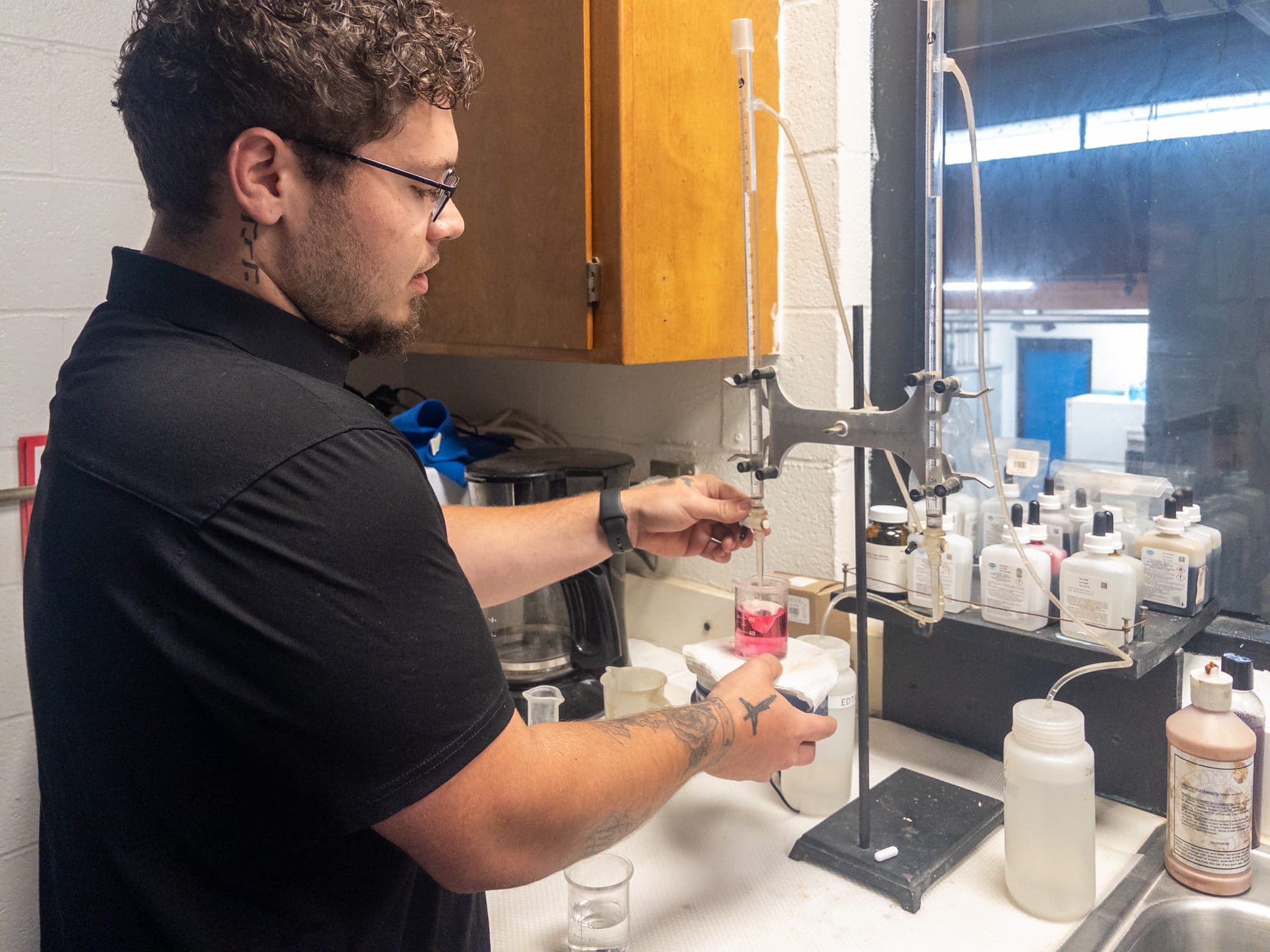
Before many Weston residents wake up, Eric and Dillon Mosier are already working to keep the city running.
Eric Mosier, Weston’s superintendent of public works, was at the city’s main sewer pump station at 4 a.m. recently after the equipment stopped working. His son, Dillon, begins work at the water treatment plant at 5 a.m., monitoring equipment, testing water and ensuring the city’s supply remains safe.
Their work often goes unnoticed — which, Eric said, is how public service is supposed to work.
“I try to serve my community as best I can,” he said. “To me, that’s kind of what it’s all about, helping other people.”
The Mosiers offer an example of how service, responsibility and a little hardheadedness can pass from one generation to the next.
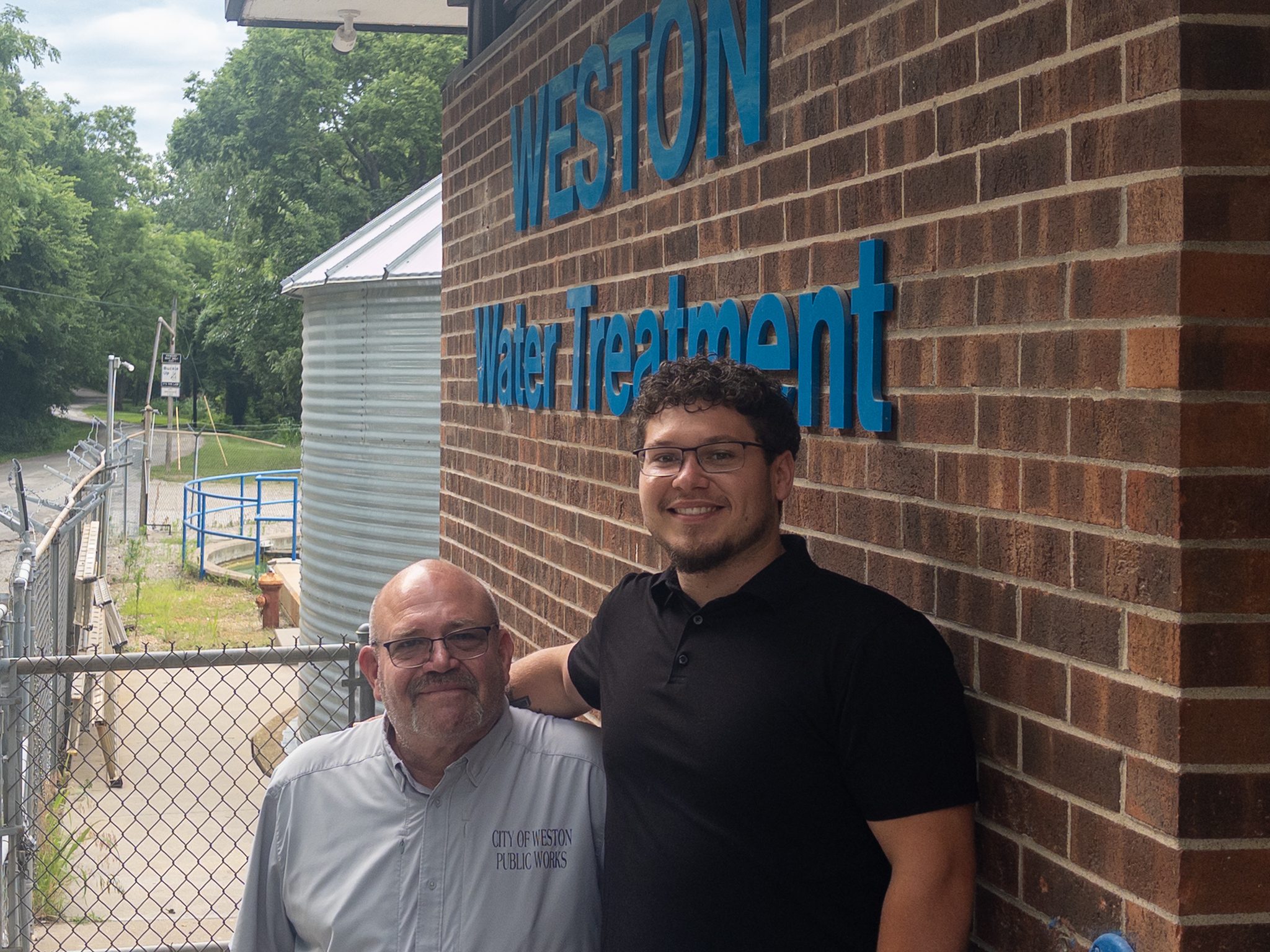
Eric oversees Weston’s streets, sewer system, trash service and water distribution. He first worked for the city from 2005 to 2007 and returned in April 2013.
“There’s always fires to put out, and everybody’s fire is bigger than the other person’s,” Eric said. “We start at 7, and we end at 4 — unless something breaks or there’s an issue.”
Dillon has worked at Weston’s water treatment plant for three years. He was promoted to superintendent about a month ago and is still adjusting to the responsibilities of leading the department.
His days are more predictable than his father’s — at least until something breaks. The plant is largely automated, but Dillon and the other operators monitor chemical levels, test the water, perform maintenance and ensure the system continues producing clean water.
“The plant kind of makes the water itself,” Dillon said. “We just make sure that it’s still putting out clean water.”
Although father and son work for the same city, they lead separate departments. Eric’s crews distribute the water throughout Weston; Dillon’s department produces it.
The arrangement has occasionally raised questions about nepotism, but Dillon said his father would be more likely to hold him to a higher standard than give him special treatment.
“He’d be the first one to get on me if I’m messing up,” Dillon said. “He’s not going to help me with anything. He’s going to tell me to do better.”
Eric agreed the departments operate independently, although public works employees have long assisted the short-staffed water plant with projects requiring additional people or equipment.
Working so close to his father also gives Dillon access to an experienced mentor — even when the advice is not particularly gentle.
“As much as it irritates me, I’m glad he’s a hard-ass,” Dillon said. “I’ve not always agreed with him, but his no-nonsense approach to life has helped me a lot.”
Eric served eight years in the Marine Corps and describes himself as a disciplinarian. Raised by his grandparents beginning at age 12, he said he grew up with an older, more traditional approach to responsibility.
“Work ethic and responsibility and integrity” were instilled in Dillon from a young age, Eric said.
Dillon admits the lessons were not always easy to accept.
“Truth hurts sometimes, but sometimes you need it,” he said. “As much as you may not like it as a kid, it’s needed.”
Now a father himself, Dillon has a new appreciation for those lessons. His daughter, Everly, is a little more than a year old.
Dillon said he did not always appreciate Weston while growing up, particularly because his father’s city job made it difficult for him to get away with much. His outlook changed as he grew older and began thinking about where he wanted to raise his daughter.
“Now that I have a daughter and I know where I want my life to go, it’s kind of where I want to be,” he said. “It’s a good little town, and I’m happy to be in the position I’m in because I care about the town.”
That connection has shaped Dillon’s vision for the water plant. Inspectors have described the facility as a “Frankenstein plant,” he said, because it includes different systems and technologies assembled over time.
Weston may not need the same equipment as a large city, but Dillon wants the plant to remain current and reliable. His goal is not simply to keep it operating, but to leave it in better condition for the next person who leads it.
“I would like to see us stay up to date with what’s going to help produce the best kind of water,” he said. “I don’t want to do just good enough. I’d rather do better than that.”
Eric said he has watched his son embrace the new position, put in extra hours and work to understand every part of the plant.
“He’s really excelled and is working really hard to do the best job that he can,” Eric said. “It makes me proud to see him.”
Their lives remain closely connected after the workday ends.
Eric lives in the house where he was raised by his grandparents. Dillon lives about 30 feet away in a former tenant farmer’s house on the same property. Eric and Dillon’s stepmother, Brooke, help care for Everly when Dillon’s workday begins before daycare opens.
The arrangement means many conversations outside work eventually return to the city, the water plant or Everly.
Dillon said being able to ask his father questions, particularly about mechanical problems, gave him confidence when he accepted the superintendent position.
“If I need anything or have a question, I can call and bother him,” he said. “There’s a lot to learn from him, that’s for sure.”
The Mosiers’ connection to the community extends beyond their city jobs. Eric said the family represents five generations of West Platte graduates, with Everly and other grandchildren continuing a legacy that would reach a sixth generation.
Eric also serves through the Masonic Lodge, the Laurel Hill Cemetery Board, the Patriots Club and the Platte County Fair Board.
His work recently earned recognition from Weston resident William Morrisroe, who praised Eric’s problem-solving, follow-through and community impact in responding to a request to have large holes patched along a portion of Citadel Drive.
Eric said recognition and compliments make him uncomfortable because acknowledgment was never the reason he served in the Marine Corps or went to work for Weston.
“I try to do as much as I can for whoever I can,” he said. “But I don’t do it because I want recognition or a thanks or anything else. I would rather do it and nobody know that I did it.”
Dillon did not grow up dreaming of a career in water treatment. He joined the plant after returning from Florida and running into former superintendent Danny Masoner, who encouraged him to apply while the department was short-handed.
What began as an available job gradually became a purpose.
“It’s just kind of developed into my way of serving the community,” Dillon said. “It’s not just a job anymore.”
For Eric, the principle is even simpler.
“A greater thing in life,” he said, “is to serve others than to serve yourself.”