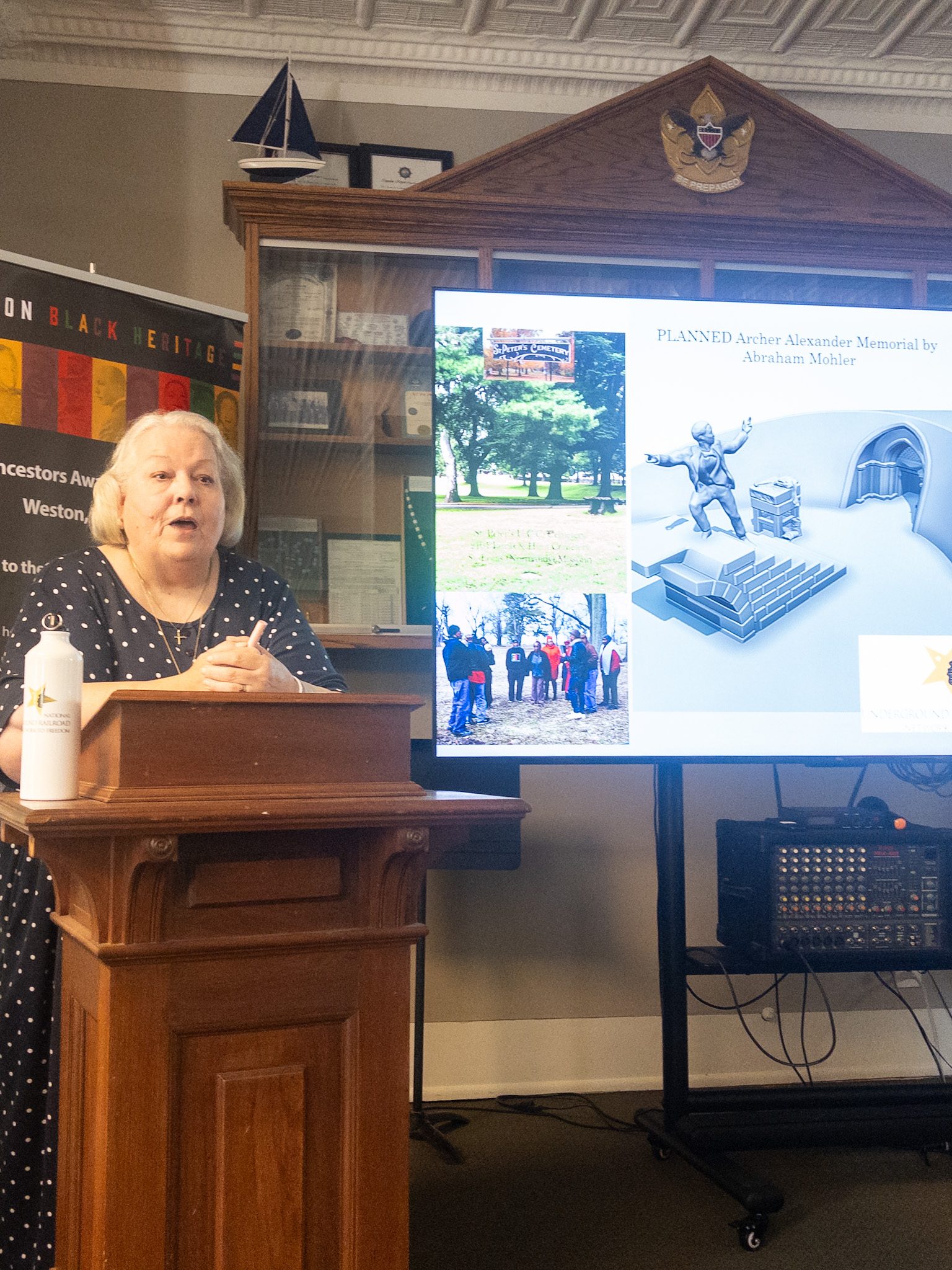
About 45 people gathered Sunday at Weston United Methodist Church to hear the story of Archer Alexander, an enslaved Missourian whose warning helped prevent the destruction of a Union railroad bridge during the Civil War and whose likeness later became part of a national monument to emancipation.
Historian and writer Dorris Keeven-Franke presented “Archer Alexander and the Underground Railroad” on July 26, opening the Black Ancestors Awareness Campaign’s 2026 Summer Speaker Series.
Now in its sixth year, the free series is sponsored in part by Missouri Humanities. This year’s theme, “The Lincoln Effect,” examines how President Abraham Lincoln’s legacy, particularly his role in emancipation, inspired institutions, laws and memorials after his death.
Keeven-Franke, a professional genealogist and archivist, traced Alexander’s life from his birth in Virginia in 1806 through his forced move to Missouri in 1829 and his escape from slavery more than three decades later.
Alexander was enslaved in St. Charles County when he overheard men plotting to sabotage a railroad bridge that served as an important connection between St. Louis and Jefferson City. He risked his life to warn Union troops, allowing them to stop rail traffic before the bridge could be destroyed, Keeven-Franke said.
As questions spread about who had revealed the plot, Alexander fled with a group of other enslaved men in February 1863. The group crossed the ice-filled Missouri River at Howell’s Ferry but was captured.
Alexander escaped again and traveled toward St. Louis, moving at night and hiding during the day. He eventually reached the home of William Greenleaf Eliot, an abolitionist, Unitarian minister and founder of Washington University in St. Louis.
Men acting on behalf of Alexander’s enslaver later seized him from Eliot’s home, beat him and took him to a St. Louis jail, according to Keeven-Franke. Eliot sought help from military authorities before Alexander could be sold and sent farther south.
Following a military investigation, Alexander received his freedom Sept. 24, 1863, under provisions of the Second Confiscation Act, an 1862 law that freed certain enslaved people whose enslavers supported the Confederacy.
Alexander later became the model for the formerly enslaved figure depicted with Lincoln in the Emancipation Memorial in Washington, D.C. The memorial was paid for by formerly enslaved people and other Black donors following Lincoln’s assassination and was dedicated April 14, 1876.
The National Park Service has recognized Alexander’s burial site at St. Peter’s Cemetery in St. Louis and programs interpreting his life through its National Underground Railroad Network to Freedom.
Keeven-Franke told the audience that Alexander’s story also challenges the tendency to portray slavery in Missouri as less harmful than slavery elsewhere.
“There’s no such thing as a good slave owner,” she said. “Without your freedom, that’s your total person.”
Her presentation also examined the research required to correct errors and omissions that had shaped the accepted version of Alexander’s life for more than a century.
Lynne Greenamyre of Kansas City said the program offered a view of history that would have remained largely inaccessible without that work.
“It’s like looking into a window that you didn’t even know was there to find a view of history that could have been hidden for centuries,” Greenamyre said.
The Black Ancestors Awareness Campaign is a standing committee of the Weston Historical Museum. Its programs are free, although donations are accepted to help cover production costs.
The series continues from 12:30 to 2 p.m. Aug. 23 in the church’s fellowship hall, 533 Main St. Debra Greene will present “Lost Campus: Lincoln University Early Buildings and Their Architects.”
The final program is scheduled for Sept. 27, when historian and educator N.M. Shabazz will discuss Black educational institutions and the legacy of emancipation.