Historian, genealogist and archivist Dorris Keeven-Franke recounted that search July 26 during the Black Ancestors Awareness Campaign’s Summer Speaker Series at Weston United Methodist Church.
Alexander’s life had been chronicled in an 1885 book written by William Greenleaf Eliot, the St. Louis abolitionist who helped him obtain freedom during the Civil War. The book said Alexander was buried at Centenary Cemetery in St. Louis County.
Keeven-Franke initially had little reason to question it.
Then she received a message from Keith Winstead of Louisville, Kentucky, an Alexander descendant who asked whether she knew where his ancestor was buried.
Keeven-Franke gave him the answer found in Eliot’s book. Winstead told her Alexander was not there.
That exchange sent her into what she described as the proverbial research rabbit hole.
Keeven-Franke searched records from Black cemeteries throughout the St. Louis area. A breakthrough came when she found two entries in a St. Louis genealogical index. One was for Julia Alexander, Archer Alexander’s second wife. The other, recorded about a year later, appeared to say “Olivey Alexander.”
The dates and other details matched, but the name did not.
Keeven-Franke said she teaches genealogy students to seek at least three independent confirmations before accepting a conclusion. One record may contain a mistake, she tells them. A second source may simply have copied the first mistake.
In this case, the original cemetery register held the answer.
After Keeven-Franke repeatedly asked cemetery employees to examine the old book, a staff member went into the cemetery’s records and photographed the entry. Keeven-Franke concluded that the original handwriting had been misread when it was indexed.
The entry was for Archer Alexander.
He had been buried in 1880 at St. Peter’s Cemetery, 2101 Lucas and Hunt Road in St. Louis, in a common burial area containing hundreds of unmarked graves. Some people were buried two or three deep, Keeven-Franke said.
The cemetery later provided space near its entrance for a future memorial to Alexander. Supporters are continuing to raise money for the project.
The burial discovery was one part of Keeven-Franke’s larger effort to separate Alexander’s documented life from a story shaped by the limitations of 19th-century publishing.
Alexander was born in 1806 in Rockbridge County, Virginia. He was taken west with his wife, Louisa, and other enslaved people in 1829. The journey separated Alexander from his mother and one of his children, who was sold and left behind.
The family eventually reached St. Charles County, where Alexander spent decades in slavery.
During the Civil War, he overheard men plotting to destroy a railroad bridge used by Union forces. Alexander warned Union troops, preventing the attack, but the decision placed his life in danger.
He fled across the Missouri River with other enslaved men in February 1863. Although the group was captured, Alexander escaped again and made his way to St. Louis.
There, Eliot and his family helped shelter him. Alexander’s enslaver attempted to recapture him, but military authorities intervened. Alexander received his freedom Sept. 24, 1863, under the Second Confiscation Act.
His story did not end with his emancipation.
After President Abraham Lincoln was assassinated in 1865, formerly enslaved woman Charlotte Scott donated $5 toward a memorial honoring him. Other Black Americans, including members of the U.S. Colored Troops, contributed to the effort.
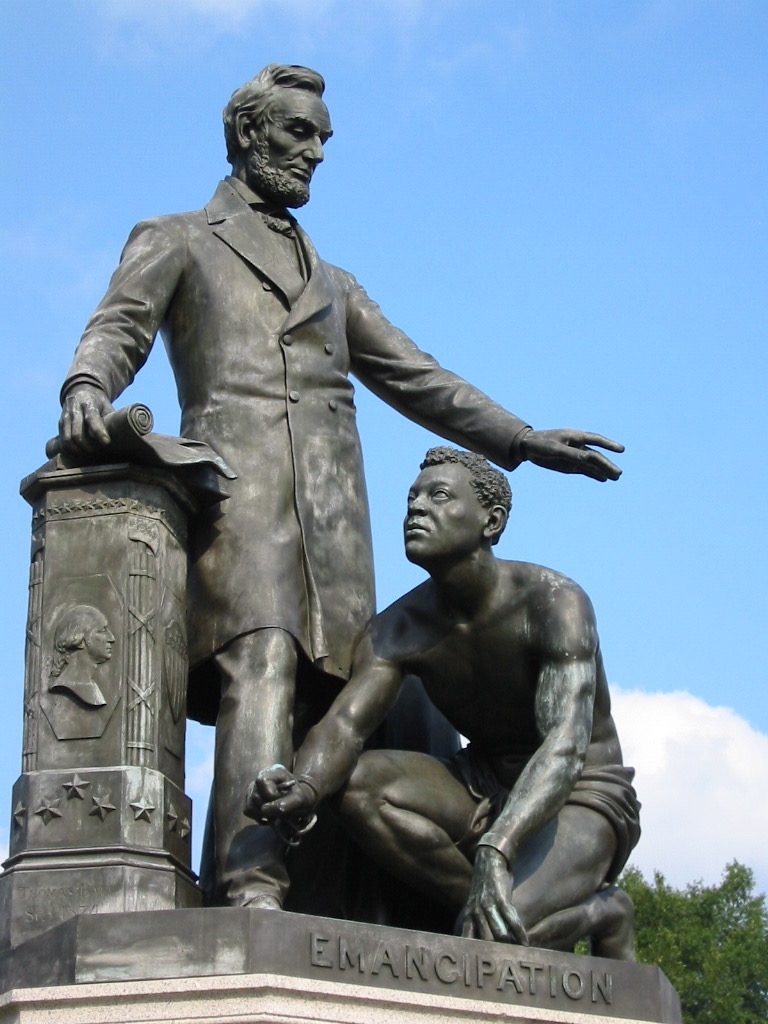
The formerly enslaved figure depicted with Lincoln in the resulting Emancipation Memorial was modeled after Alexander. The memorial was dedicated in Washington’s Lincoln Park on April 14, 1876.
The National Park Service now recognizes Alexander’s burial site and interpretive programs about his life through the National Underground Railroad Network to Freedom.
Genealogical and DNA research has also connected Alexander’s family to boxer Muhammad Ali, who was among his descendants, Keeven-Franke said. Members of the extended Alexander family have since participated in commemorations honoring their ancestor.
But reconstructing his life has required more than correcting a cemetery index.
Eliot wrote his book near the end of his life, when publishers feared lawsuits if accounts identified real people accused of wrongdoing, Keeven-Franke said. Some names and details were changed, leaving later generations with a story that blended documented history with altered information.
“It’s not that it was intentionally whitewashed,” she said. “But when Eliot was writing the book, it was right near his end of life.”
Keeven-Franke has used military depositions, newspaper accounts, cemetery registers, genealogical indexes, family records and archival manuscripts to reconstruct Alexander’s life.
“It became important to me,” she said. “How many years have we said how people whitewash the story? That is not what happened here, and that’s why it’s so important for me to explain how it got changed.”
Her work also leaves unanswered questions.
Researchers do not yet know what happened to most of the men who attempted to escape with Alexander. Records identify some of the households from which they fled, but their names and later lives remain difficult to trace.
Louisa Alexander’s final resting place is also unknown.
Those gaps are part of what keeps Keeven-Franke searching.
“You’ve got to go out and dig,” she said. “You’ve got to go out and check.”
For Greenamyre, who attended the Weston presentation, that persistence was what made the program memorable.
“It’s like looking into a window that you didn’t even know was there,” she said, “to find a view of history that could have been hidden for centuries.”