One of the most helpful messages I received following last week’s election began with a confession.
A longtime reader told me that, in years past, whenever the Chronicle endorsed a candidate or ballot measure, the reader knew exactly what to do: vote the opposite way.
The reader had reviewed the editions published since I took ownership and wrote, “I have not noted a political bias. I think this is a good thing.”
The reader also expressed a belief that, when a newspaper publishes one political viewpoint, it should make room for opposing views so people can form their own opinions.
I agree.
That candid observation stayed with me—not as a criticism of previous publishers, who had every right to express their views, but as a reminder of how closely readers pay attention to a newspaper’s editorial voice. The rest of the message helped clarify the approach I want to take.
The Weston Chronicle carries a Democratic “political faith” designation under Missouri’s election-notice system. It is an old legal designation used by the state when selecting newspapers to publish election notices and proposed constitutional amendments. It does not require our news coverage to favor Democratic candidates or causes, nor does it give us permission to treat Republican, Libertarian or independent voters as though their perspectives matter less.
My goal is not to produce Democratic news or Republican news. It is to produce verified local news that helps you make informed decisions based on what is best for you, your family, your business and your community.
That brings us to Missouri’s Aug. 4 election.
According to results available at press time, voters approved Amendment 1, continuing the existing one-tenth of 1% sales and use tax for soil and water conservation, state parks and historic sites for another 10 years.
They also approved Amendment 2, requiring all charter counties, including Jackson County, to elect their county assessors and requiring those assessors to comply with state training requirements.
Voters rejected Amendment 4. As a result, citizen-initiated constitutional amendments will continue to require a simple statewide majority rather than majority approval in each of Missouri’s eight congressional districts.
They also rejected Amendment 5. Missouri’s individual income tax will remain in place under current law, and the General Assembly will not receive the expanded authority proposed in the amendment to phase it out through changes to sales and use taxes.
Those results do not fit neatly under one partisan label. Missouri voters continued an existing sales tax, supported electing an additional public official, preserved the current statewide-majority standard for citizen initiatives and declined a proposed restructuring of the state tax system.
That does not necessarily mean Missouri moved to the political left or right. It means voters considered four separate questions and reached four separate conclusions. A party label alone cannot explain an entire ballot—or an individual voter.
The primary also determined which candidates will represent their parties in November. Between now and the general election, the Chronicle’s responsibility is to help readers understand who those candidates are, what they propose, what their records show and how their decisions could affect our communities.
Opinion still has a place in a newspaper. Strong disagreement and pointed criticism are welcome, but opinion is not a license to invent facts or make personal attacks.
The Chronicle will not knowingly publish false factual claims, unsupported accusations or attacks unrelated to the issue being discussed. Submissions should focus on decisions, policies and conduct that can be documented, and they may be edited or rejected if they do not meet those standards. Readers should always be able to tell the difference.
A straight answer about subscriptions
Political coverage is not the only subject generating feedback. An upset reader also reached out to ask why our annual subscription price increased to $45 and why we no longer offer separate in-county and out-of-county rates.
For some readers, the price nearly doubled. That is significant, and you deserve a direct explanation.
The previous subscription rate had remained too low for too long and no longer reflected the cost of printing, mailing and producing a newspaper each week.
The new $45 annual subscription also includes more than the former print-only product: weekly home delivery, unlimited website access, the weekly e-paper and access to our online article archive. That amounts to less than 87 cents per week for both print and digital access.
We also offer a $30 annual online-only subscription, monthly payment options and limited free access to several articles each month.
Readers who only want the printed newspaper may still purchase individual copies for 50 cents from Chronicle boxes around town. That longstanding price has not changed. Box copies do not include home delivery or digital access and are available while supplies last, but the lower-cost print-only option remains available.
We moved to one subscription price because most of the expense of serving a reader—reporting, photography, editing, design, printing and digital infrastructure—does not change at the county line.
Although mailing costs can vary, postage is only one part of the total expense. A single rate is also easier to understand and administer, and every print subscriber now receives the same digital benefits.
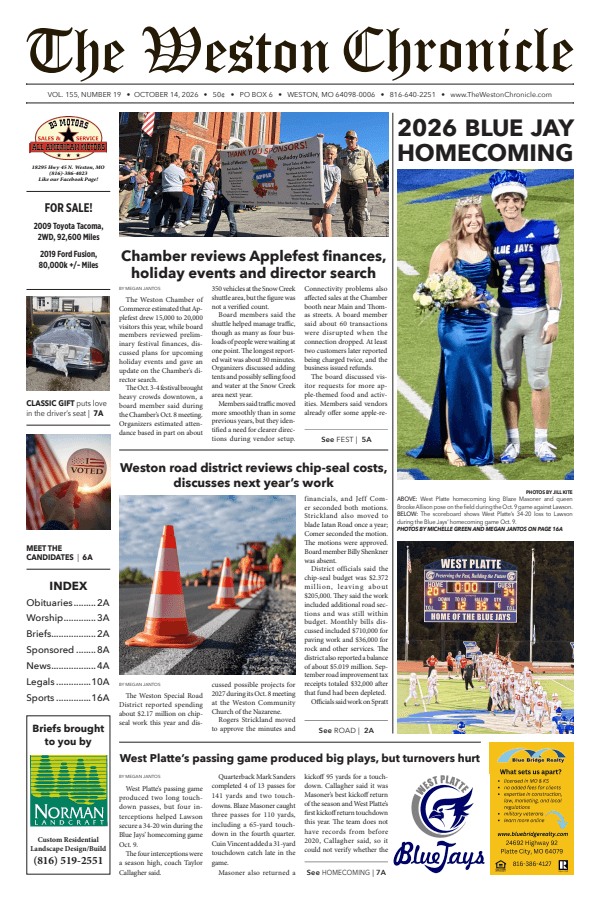
Since taking ownership, we have launched a new website, introduced online subscriptions and a weekly e-paper, added an article archive and created online options for submitting stories, obituaries, classifieds and advertisements.
We are still at the beginning, and I know asking readers to pay more requires us to deliver more. That is the standard I am setting for the Chronicle.
Whether the subject is subscription prices, political coverage or the decisions shaping our community, you may not always agree with what appears in these pages. Agreement is not what I promise.
What I promise is that we will tell you what we know, explain how we know it, distinguish fact from opinion and give you the information you need to reach your own conclusions.
That is what a newspaper owes its readers. Please continue telling me how we are doing.