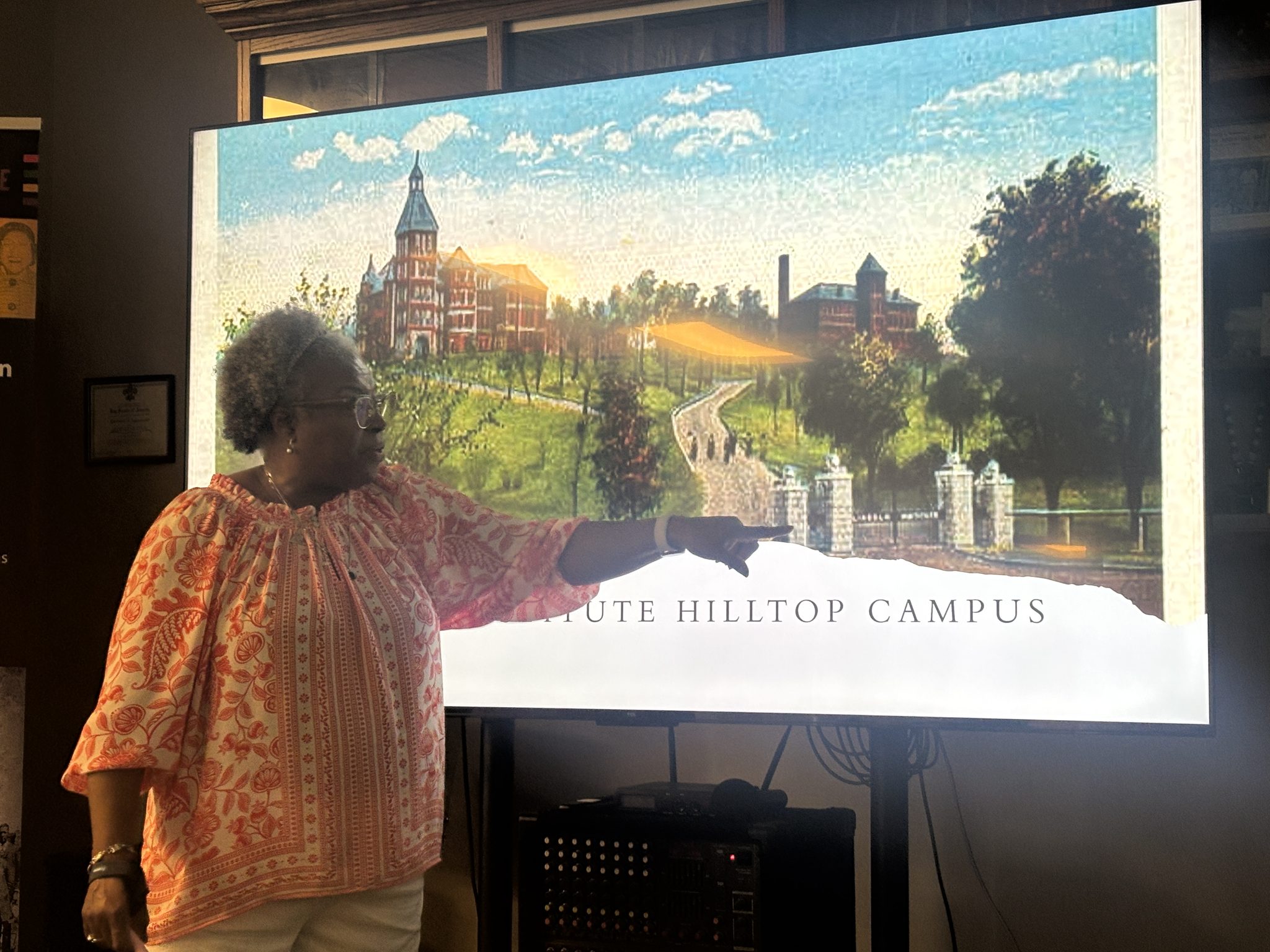
The eight buildings that made up Lincoln Institute’s early campus are gone, but historian Debra Foster Greene told a Weston audience Sunday that their disappearance demonstrates why communities must preserve more than attractive old structures.
Greene, a professor emerita of U.S. history at Lincoln University, spoke Aug. 23 during the Black Ancestors Awareness Campaign’s fifth annual Summer Speaker Series at Weston United Methodist Church. Her presentation, “Lost Campus — Lincoln University Early Buildings and their Architects,” examined the buildings, architects, contractors and suppliers that shaped the university’s early campus.
The event was part of BAAC’s 2026 theme, “The Lincoln Effect,” exploring how Abraham Lincoln’s legacy, particularly his role in emancipation, inspired institutions and laws long after his death.
Lincoln Institute was founded in Jefferson City in 1866 through contributions from enlisted men and officers of the 62nd and 65th U.S. Colored Infantry regiments. The university is celebrating its 160th anniversary this year.
Greene said her research began as an architectural study but revealed a larger story about the relationship between the historically Black institution and Jefferson City.
Black educators developed Lincoln’s curriculum and led the institution, while Jefferson City architects, contractors and suppliers constructed its physical campus. The buildings reflected the same Second Empire, Queen Anne, Gothic and Romanesque styles found in the city’s homes, churches and public buildings.
“Those buildings were a physical manifestation of the connection between the city of Jefferson and Lincoln University,” Greene said.
Lincoln’s first campus building, Academic Hall, was dedicated in 1871. It was destroyed by fire in 1894 and replaced by Memorial Hall Memorial Hall was damaged by another fire in 1968. Greene said university leaders decided in 1972 to spend about $30,000 to demolish the structure rather than an estimated $1 million to repair it. Its demolition removed the last major physical link to Lincoln Institute’s original campus.The oldest building remaining from the institute era is a power plant constructed in 1922.
Greene said the loss of the early campus also obscured evidence of the businesses and residents who helped Lincoln grow. Architectural records, university reports and meeting minutes allowed her to reconstruct some of those relationships after the buildings themselves disappeared.
That message carries particular relevance in Weston, where BAAC has worked to restore Black residents and their contributions to the town’s public history.
The organization, a standing committee of the Weston Historical Museum, has helped establish the Dinah Robinson Courtyard, Blackhawk Walk, Weston’s Black Heritage Mural and other elements of what it calls a “museum without walls.”
BAAC founder Angela Hagenbach said her research at Lincoln also uncovered connections between the university and Weston. Her great-aunt Emma attended Lincoln Institute, earned a degree in education and later taught in St. Joseph. Hagenbach said she also found the names of several other Black Westonians in early Lincoln records, although some of those records are incomplete.
Greene praised BAAC for pursuing history that frequently receives little attention in rural community histories.
“Most small towns, they don’t tell the story of their African American population,” Greene said.
Michelle Harmon-Cook of Liberty, who assists with BAAC events and directs the Salus Populi Pension Project, said she has watched Weston residents support efforts to confront and preserve the town’s complete history.
She called that community support “a shining beacon” for other towns where fear or discomfort can make similar projects difficult.
The presentation also brought back memories for Barbara Fredholm, who attended Lincoln University in the early 1970s. Fredholm said a sociology professor there inspired her to pursue a career in social work.
“It was such a comfortable place for me to be,” Fredholm said.