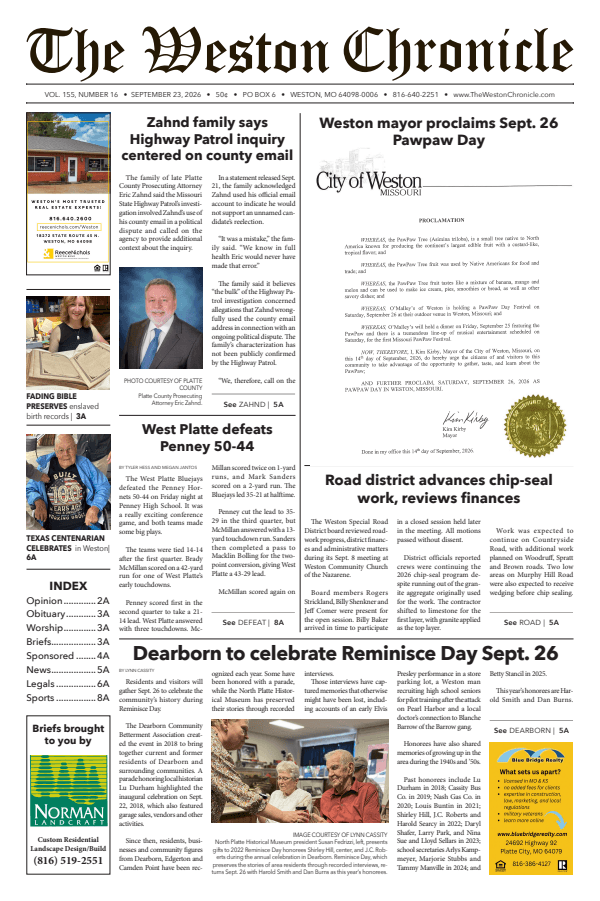
A Nower family Bible containing a rare record of enslaved people born on a farm near Pleasant Ridge Church took center stage Sept. 17 at the Weston Historical Museum, where its fading pages also illustrated the challenges of preserving the museum’s collection.
Museum curator Shelly Franklin presented the Bible during the museum’s monthly History Mystery Hour, which gives visitors a closer look at unusual artifacts and the stories they hold.
The Nower family farmed west of Pleasant Ridge Church. In addition to recording births and deaths within the family, the Bible lists enslaved people born on the property.
Records of that kind can be found elsewhere, Franklin said, but they are rare. They can preserve names and other information about people whose lives were often omitted from traditional historical records.
The page was once displayed open at the museum. An undated museum article believed to be from the 1960s described the writing as clear and easily readable. Decades of exposure to light have since caused much of the ink to fade.
Museum staff displayed a darkened reproduction and a previously transcribed list of names alongside the original page so visitors could see information that is now difficult to read.
“You’ve seen issues with pages that have been overexposed to light over the years,” Franklin said. “There’s nothing you can do to bring it back.”
The Bible was one of several displayed during the program, which focused on books donated by Weston-area families and churches.
At one end of the display was a massive Barton family Bible containing family records, a photograph believed to be of Thomas G. Barton and a copy of his marriage certificate to Clara Holladay Barton. Clara Barton was the daughter of David Holladay, who operated the Holladay Distillery.
At the other end was a “thumb Bible,” a miniature book so small that visitors needed magnifying glasses to examine its pages.
Franklin said miniature books became popular during the 18th and 19th centuries as advances in printing made extremely small type possible. Thumb Bibles generally did not include the complete biblical text. Instead, they contained selected passages and illustrations and were marketed in part as novelties for children.
The contrast between the museum’s largest and smallest Bibles attracted attention, but the books’ condition pointed to a more serious issue facing the museum.
“We have preservation issues with almost everything in the collection, but they’re different kinds,” Franklin said.
Books, photographs, textiles and other objects require different methods of storage. Textiles, for example, should be protected with acid-free tissue and stored in archival boxes to prevent deterioration and permanent creases.
The museum needs more archival materials, but Franklin said its larger problem is a shortage of storage space.
“We have no storage,” she said. “All of these things are tied together.”
Museum staff members are working through the collection item by item to identify artifacts, assess their condition and determine how they should be stored. Some older books had been kept in plastic bags in a room that becomes too warm. Staff members are now preparing cooler storage space downstairs.
Helping lead that effort is Reilly Hash, the museum’s new museum technician. Hash holds a bachelor’s degree in art history and recently earned a master’s degree in history from the University of Central Missouri. She previously interned with the American Jazz Museum’s collections department and the Missouri State Archives.
Hash said proper storage involves more than placing an artifact in any available box. Archival boxes, acid-free tissue, protection from direct sunlight and proper positioning can help extend an object’s life.
Small and medium-sized books generally should be stored upright to protect their spines, she said, while oversized books and atlases should be laid flat because of their weight.
The spine of the large Barton Bible already is damaged. Hash and Franklin built a temporary cradle the night before the program to support the book while it was displayed open.
“We couldn’t keep it open properly without support,” Hash said.
Hash also has been replacing older tissue paper that is not acid-free and reorganizing books, photo albums and other objects.
The museum must first understand what it has before staff members can determine the best long-term care for each item, Franklin said. Volunteers could eventually help with the work, although different kinds of artifacts would require specialized training and supervision.
For Hash, preserving an object begins with understanding its connection to the community.
“Who did this belong to? Which family? Why is this important? And what does it have to do with Weston?” Hash said. “Those are the kind of thoughts that I have when I’m thinking about some of the objects I’ve gone through.”
History Mystery Hour is held from 5 to 7 p.m. on the third Thursday of each month, except in January and February, at the Weston Historical Museum, 601 Main St. The free program began in July and is supported in part by a Richard S. Brownlee Missouri Local History Grant from the State Historical Society of Missouri.