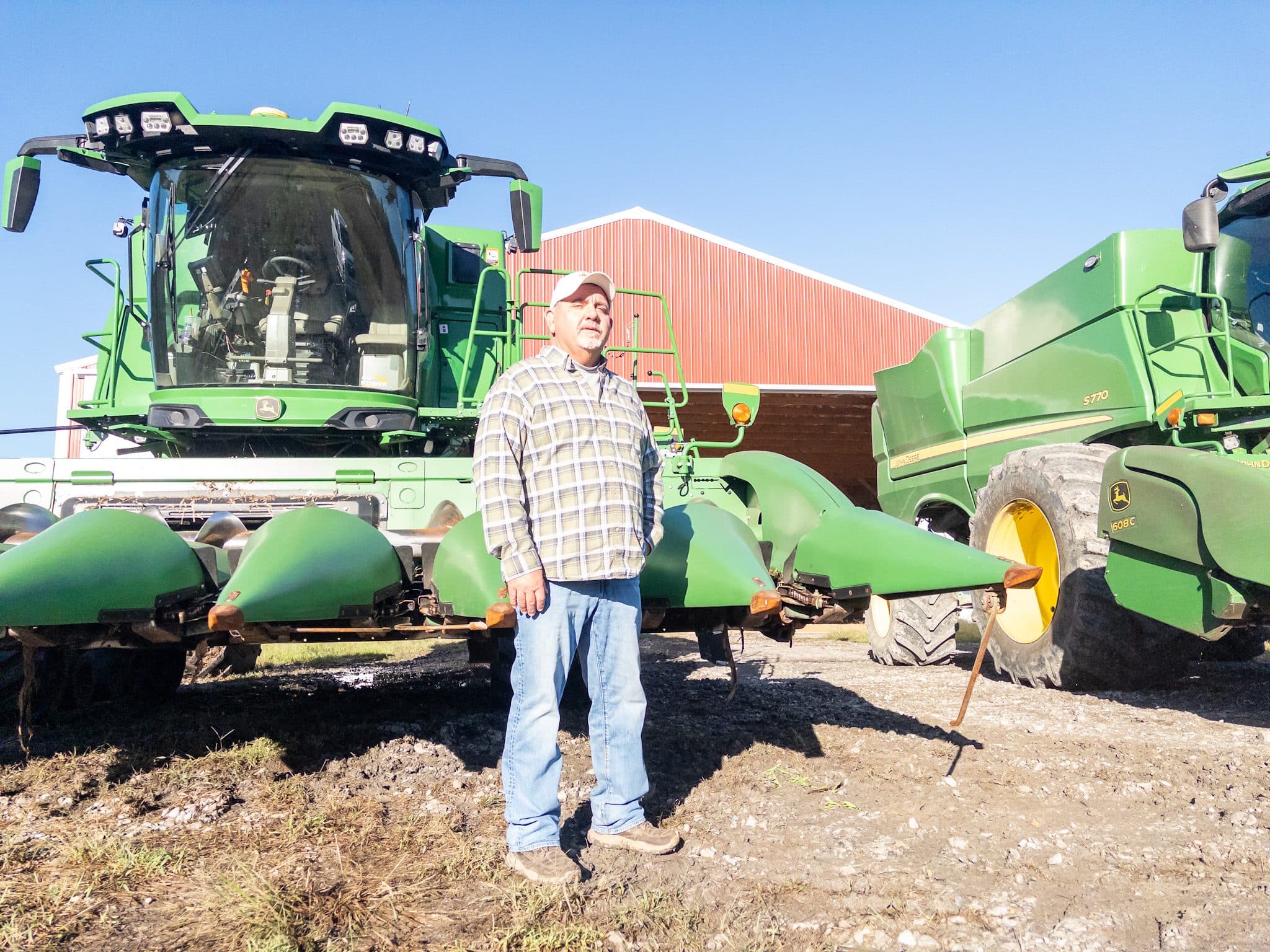
For Brian Miller, moving farm equipment from one field to another is often the most dangerous part of the job.
The Rushville-area farmer has worked the land for more than 40 years, beginning with tobacco when he was 13. Today, his family raises corn, soybeans and cattle on farmland spread across roughly 20 to 25 miles. That means tractors, combines, semitrailers and other equipment must regularly travel public roads.
“We don’t want to be there either,” Miller said. “We’d rather be in our fields. But we have to move this equipment to get to our fields.”
Overgrown brush and trees can make those trips even more dangerous by limiting visibility near intersections and hills. Rather than simply accepting the problem, Miller contacted the Missouri Department of Transportation.
Tonya Lohman, MoDOT’s district maintenance engineer, spoke with Miller by phone and then met him to drive the route together.
“We have brush on routes that we would like to cut back, as well as trees we plan to cut down,” Lohman said.
Following that assessment, MoDOT crews cut brush and removed some trees along Highway 45 near several county road intersections. The agency also addressed concerns raised by other residents, including tree limbs along Route H that limited drivers’ ability to see approaching traffic across a vertical curve — a stretch where the road descends and rises again.
Miller credited Lohman with getting the work moving.
“She’s been an extremely positive figure in this,” he said. “She’s really the person responsible for getting a lot of this done.”
The result illustrates how local knowledge can help government agencies identify problems and direct limited resources. It also highlights the constraints facing the crews responsible for maintaining state roads.
Lohman said Platte County maintenance crews frequently work together because MoDOT has been unable to fully staff its facilities in Platte City, Nashua and Northmoor. The district is typically short between 12 and 20 employees across the three locations.
Weston Police Chief Kelly Clark said those shortages can affect how quickly crews reach northern Platte County. MoDOT operations previously based in Tracy have been moved to Northmoor, requiring workers to travel farther when responding to concerns around Weston.
“MoDOT just doesn’t have enough people,” Clark said.
Clark said cooperation among agencies and residents becomes especially important after storms. Platte County sheriff’s deputies frequently carry chainsaws and can cut fallen trees, while the West Platte Fire Protection District can also help clear roadways. Their immediate goal is often to move debris far enough to reopen the road until additional work can be completed.
“If homeowners help, it just helps so much,” Clark said.
Clark, who also owns a farm outside Weston, said he tries to keep vegetation cut back on his own property because thick brush can make it difficult to see approaching traffic.
For MoDOT, roadside vegetation management serves several purposes beyond improving visibility during the growing season. Lohman said the agency plans to continue cutting brush near bridges, signs and interstate ramps. Crews will also address lettered routes to improve views of signs and intersecting roads.
Removing vegetation can also help snow blow across the roadway instead of accumulating and allow sunlight to reach the pavement, assisting with snow and ice removal during the winter.
Residents can report vegetation, potholes and other roadway concerns by calling 888-ASK-MODOT or visiting www.modot.org. Lohman encouraged callers to provide specific locations and descriptions.
“The better the details, the easier for us to find the issue and get it addressed,” she said.
Providing a name, telephone number or email address also allows MoDOT employees to follow up and confirm whether the concern was addressed.
Lohman said motorists may not understand the limitations faced by operators of large, slow-moving vehicles. That includes farmers transporting tractors and combines, MoDOT employees hauling excavators or mowing around signs and guardrails, and tractor-trailer drivers who cannot accelerate quickly or see vehicles in their blind spots.
Miller said his equipment has mirrors, cameras, lights and flashing beacons. Operators generally know when vehicles are behind them and will pull over when they find a safe place.
“We know you’re there. We see you,” Miller said. “We don’t like to be on the road taking up your time.”
Finding a safe place to move aside, however, may take time. Narrow shoulders, guardrails and mailboxes can leave little room for equipment that may span much of the roadway. Miller said motorists should wait until they can clearly see that it is safe to pass instead of assuming the equipment operator will wave them around.
Miller said most drivers are courteous, and he tries to acknowledge them with a wave when they stop or make room for his equipment. Others follow too closely, attempt unsafe passes or become visibly angry.
Clark said he recently watched a driver travel faster than 70 mph and pass in no-passing zones three times while approaching Weston. The driver nearly met oncoming traffic head-on before pulling back into the proper lane.
“You’re just going to kill yourself and somebody else,” Clark said. “Nothing’s that important.”
Both Miller and Clark urged motorists to slow down, pay attention and allow additional time, particularly during planting and harvest seasons.
The cooperation between Miller and MoDOT shows that improving road safety does not always begin with a major project. Sometimes it begins with a resident making a phone call, a public employee willing to listen and both sides taking the time to examine the problem together.
Lohman acknowledged that residents sometimes believe government employees do not care, while agencies may struggle against the perception that they have unlimited money, personnel and time. She said MoDOT employees must make careful decisions about how to use state gas-tax revenue for needs such as patching potholes, purchasing salt and cutting brush.
“When we all work together to solve the issues affecting a community, a group of farmers or a school district, then we all buy into the solution and try to keep the investment going,” Lohman said. “I am a firm believer in supporting our communities and their citizens and am grateful to Brian for working with me to develop a plan.”