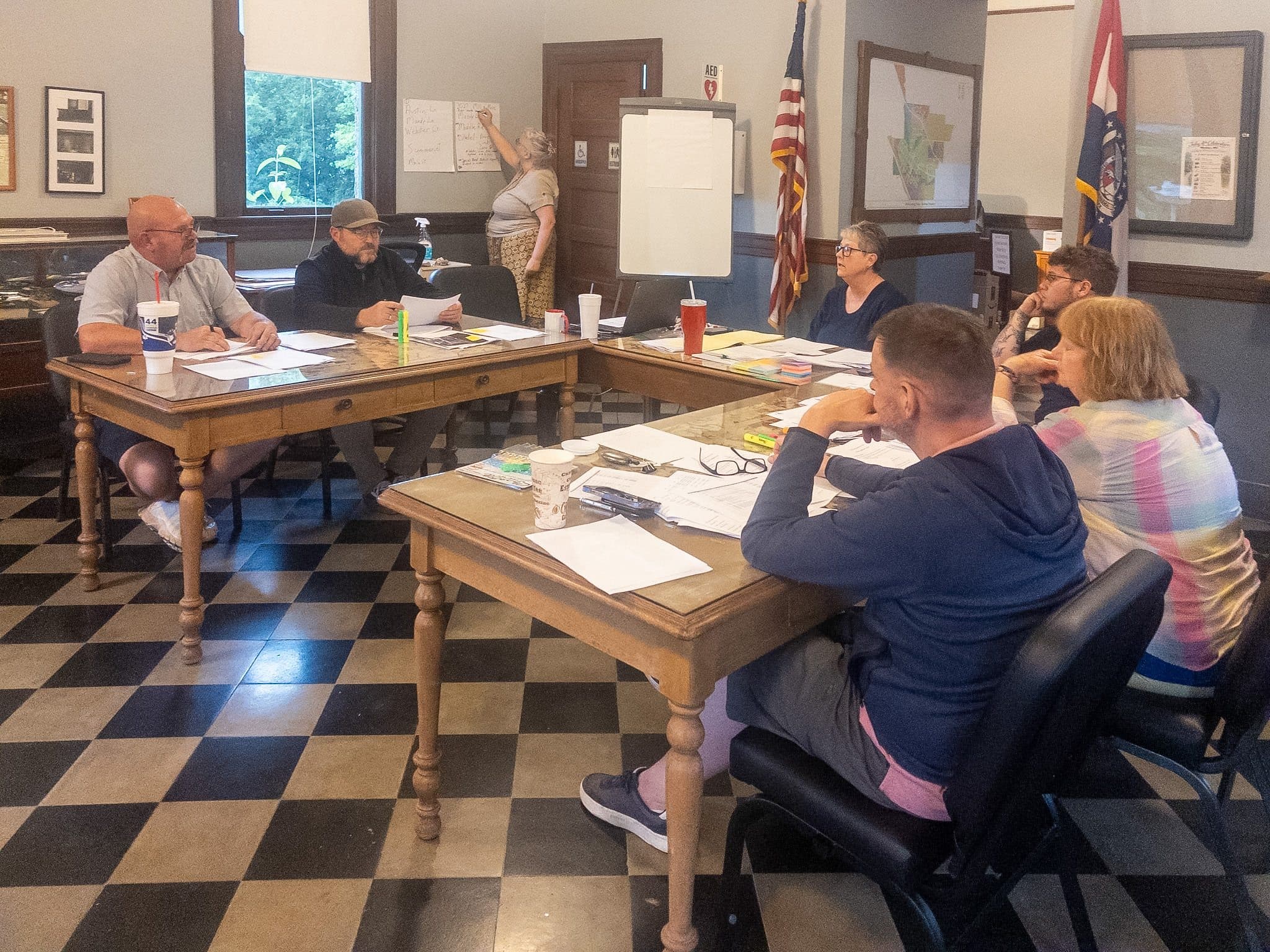
Weston officials took an initial step toward addressing some of the city’s most troubled roads June 25, reaching a consensus during a special Board of Aldermen meeting to seek engineering proposals for five priority street projects.
The board identified Austin Lane, Webster Court and Summerset as the most urgent concerns, with Main Street and Mandy Lane also included in the group of projects to be evaluated. The engineering work would determine what is causing the damage, what repairs are needed and how much construction could cost.
Water has been observed coming through cracks in Austin Lane during heavy rain, prompting concerns about cavities beneath the pavement. City officials said the street may require a complete curb-to-curb reconstruction, although an engineer will have to determine the cause of the damage, the required repairs and how residents could maintain access during construction.
Main Street and Mandy Lane were added to the proposed engineering package because both may require more than routine resurfacing. Main Street could need storm sewer, substructure and waterline improvements in addition to pavement work.
Alderman Greg Hoffman proposed asking the city’s engineering firms to submit costs for each street individually and as a combined package. That would allow the city to determine whether bundling the fieldwork, surveying and design would reduce costs.
Officials said their goal is to complete as much engineering as possible in 2026 so projects could be ready for construction beginning in spring 2027. The city may have to rank the streets again after receiving cost estimates.
The discussion was part of a broader effort to create a capital improvement plan covering streets, water and sewer systems, city facilities, equipment and other infrastructure through at least 2029.
Mayor Kim Kirby proposed returning the street department’s routine operating expenses to the general fund and reserving dedicated transportation, road and capital improvement revenue for larger projects.
The city expects to receive approximately $745,000 from several dedicated revenue sources in 2027, based on current estimates. After a roughly $154,000 bond payment for the Washington and Spring street project, the city could have about $590,000 available for eligible capital work.
Weston’s new 1% sales tax is expected to take effect in October. Kirby estimated it could generate about $64,000 during the final three months of 2026. The proposed funding structure will be considered further as the city develops its 2027 budget.
Officials emphasized that dedicated revenue would still have to be tracked separately and spent only for legally permitted purposes. County road tax revenue, for example, could not be redirected to an unrelated building project.
Water system projects would also remain primarily supported by water rates and the city’s Water Improvement Fund rather than the new sales tax. Officials said the capital plan should identify the anticipated funding source for each project and account for long-term equipment replacement when future water rates are calculated.
One of the largest water plant proposals is a Supervisory Control and Data Acquisition system, commonly known as SCADA. The system would monitor plant equipment, store operating data and alert employees when problems occur.
One proposal totaled approximately $204,000 before optional equipment, which could increase the price to about $224,000.
The board agreed to begin developing a detailed scope of work so competing companies would bid on the same equipment and capabilities. Hoffman said the city should favor an open system that would allow it to work with multiple vendors instead of becoming dependent on one company for updates and repairs.
“When we get bids, we’re looking at apples to apples,” Hoffman said.
Water plant staff will begin assembling the scope, and the city could ask an engineer to review or complete it. Major purchasing and installation are expected to be considered for 2027.
Officials also discussed several smaller water plant projects that could move forward sooner if funding is available. Those include replacing deteriorated laboratory cabinets, improving the plant’s backup lime-feeding system, replacing portions of the security fence and repairing the entrance platform and railings.
A laboratory cabinetry proposal was estimated at approximately $9,700.
Water staff will also compare the city’s current carbon dioxide costs with the cost of purchasing a 750-pound bulk tank. The proposed tank would cost $6,420, compared with an $80 monthly rental option. The analysis will include installation, delivery, hazardous-material and recurring carbon dioxide costs.
On the sewer side, the city plans to contact Bank of America before paying for engineering to connect the wastewater system to an additional irrigation pivot on bank-owned property. Officials said the connection could provide enough additional treatment and application capacity to support approximately 125 more homes.
The city will first determine whether the property owner will permit the connection and what conditions would apply.
Officials also directed staff to obtain guidance on replacing or upgrading the generator at the city’s main sewer lift station. The existing generator can operate one pump but cannot support both pumps simultaneously. If both attempt to start during an outage, the demand can shut down the generator and leave the station without power.
Generator sizing or engineering work was placed on the city’s 2026 project list.
Other projects were assigned tentative later dates. Public Works yard paving and improvements could be considered in 2027, while downtown and City Hall parking lot redevelopment and Public Works building repairs were generally placed in the 2028-29 range.
In separate action, the board voted 3-0 to approve a business license for Mile High Fireworks and allow the business to operate immediately through July 4. The exception was needed because the city ordinance normally permits fireworks sales beginning June 27.