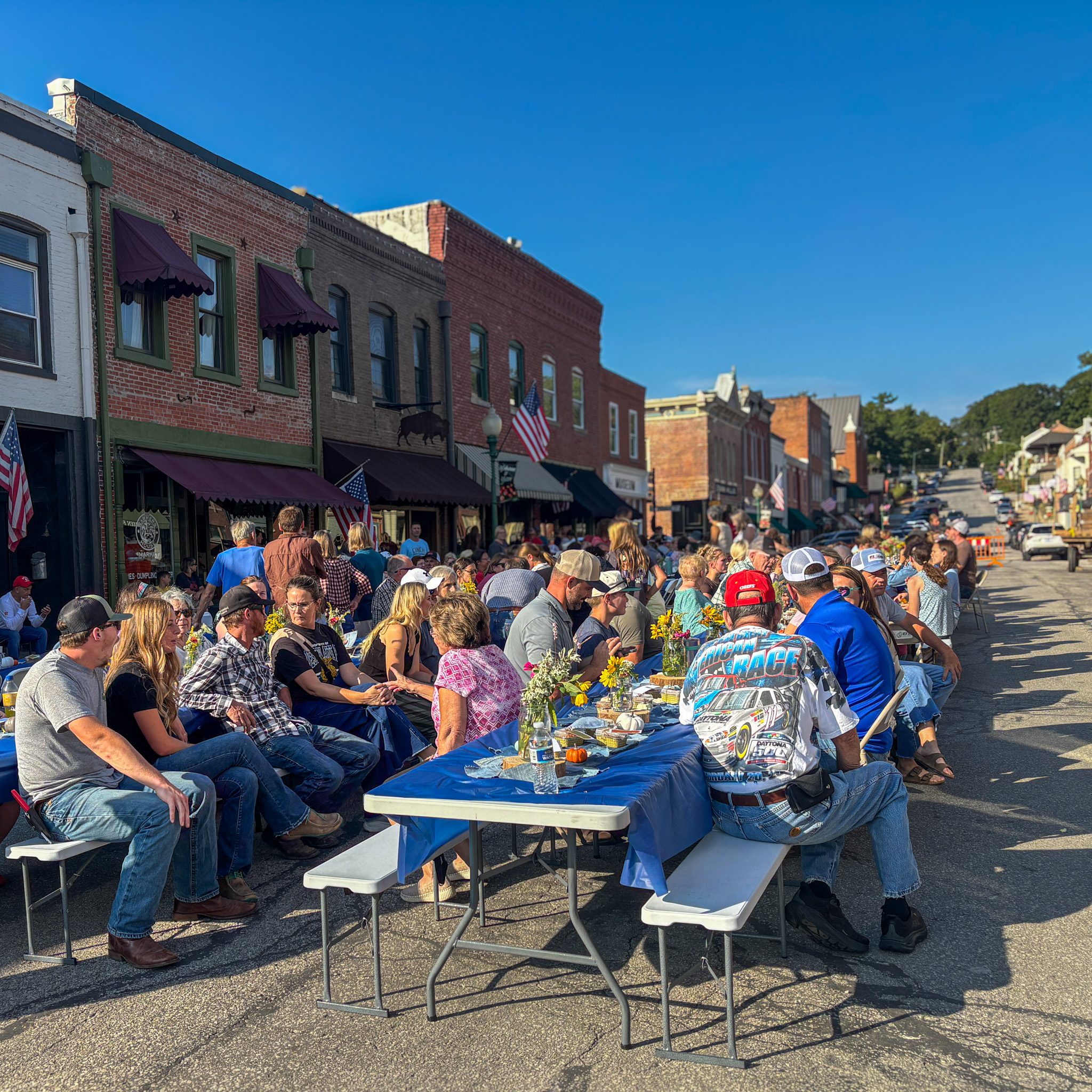

More people gathered around Weston’s harvest table Sunday than ever before, but one of the clearest signs of growth could be found among the students serving them.
West Platte FFA welcomed 315 members and guests to its annual Harvest Dinner on Main Street, continuing a community tradition that began a decade ago. Agriculture teacher and FFA adviser Carmen Buller said the chapter has grown from about 30 members when she arrived at West Platte to 53 this year.
The increase comes as traditional production farming is consolidating into fewer, larger operations and becoming increasingly difficult for newcomers to enter. But Buller and her students say agriculture is not disappearing. It is changing.
“The smaller farmer is probably decreasing when we think of just a traditional production farmer,” Buller said. “However, there is a lot more going into the industry.”
Modern agricultural careers include operating GPS-guided equipment, using drones to identify pests and crop problems, repairing increasingly sophisticated machinery and working in areas such as science, technology, business and communications, she said.
“Not very many people are going into the role of production farming because it’s very expensive,” Buller said. “If you weren’t a farmer, it’s hard to get into it.”
That does not mean students need to grow up on a farm to find a place in FFA.
Chapter President Vivian Jones said she lives in a house in Weston and did not come from an agricultural family. Her interest began more than 3,000 miles away while her family was living in the Netherlands, where her father worked as a U.S. diplomat.
Jones grew up near Dutch farmland surrounded by dairy cattle. When her family prepared to return to the United States, she said finding a school with an FFA chapter was one of her priorities.
“It was always kind of my dream to be a part of it,” Jones said. “I didn’t really know what it entailed, but I knew I wanted to be a part of it.”
Jones enrolled at West Platte midway through her freshman year in early 2025 and became involved in the chapter. She has since competed twice at the state level in public speaking and serves as both the West Platte chapter president and an Area 1 FFA officer.
In 2025, Jones won the Missouri Teach Agriculture State Speaking Championship and placed first nationally in the FFA #SpeakAgShowcase. Although she initially became interested in dairy farming, she said public speaking and leadership have become some of her favorite parts of FFA.
The organization’s reach beyond production farming is reflected in its name. Formerly known as the Future Farmers of America, it adopted the name National FFA Organization in 1988 to reflect the growing diversity of agriculture. National FFA now describes its mission as preparing students for leadership and careers in the science, business and technology of agriculture.
Jones said that evolution is sometimes mistaken for decline.
“Agriculture dying versus agriculture evolving could be easily mixed up,” she said. “Being involved in agriculture doesn’t necessarily look like being on the farm. It can also look like being heavily involved in the technology side of things.”
Missouri FFA reports having 26,830 members. The organization says today’s members are preparing to become not only farmers but also biologists, chemists, veterinarians, engineers and entrepreneurs.
The Harvest Dinner provided West Platte students with a practical lesson in another part of the FFA mission: service.
Members spent much of the preceding week chopping vegetables, preparing dishes and storing food in the school kitchen. They completed the cooking and baking Sunday morning before moving the meal downtown.
“The FFA organization — our chapter — does everything here,” Buller said. “They’ve been prepping it all last week.”
The Scouts contributed dessert, including fruit cobblers prepared in cast-iron Dutch ovens. Triumph Foods donated meat, while the Cook family, Mr. James, local growers, Sharps and other community supporters helped provide food or supplies. The New Deal loaned tables and chairs for the event.
Not everything could be sourced locally this year. Buller said extreme summer heat damaged area gardens, requiring organizers to supplement some of the vegetables and purchase potatoes that would ordinarily have come from a local producer.
Students did not appear disappointed that they were spared the job of washing, peeling and shredding hundreds of pounds of potatoes, she joked.
Despite the size of the crowd, Buller said this year’s dinner was the least stressful she had experienced because students assumed responsibility for much of the work.
“I have really good students who take care of things,” she said. “I almost felt like I was forgetting half the meal because I was not worried or bothered.”
The dinner has grown steadily since its beginning. The Weston Chronicle reported that 225 people attended the inaugural event in 2016. More than 250 attended the following year, when freewill donations raised $2,156 for West Platte FFA and Weston Boy Scout Troop 249.
This year’s 315 attendees filled rows of tables stretching along Main Street as students refilled drinks, served food and visited with neighbors.
Jones said the event brings together people who may live near one another but do not often have an opportunity to sit down together.
“You’ll see cousins meet up who don’t usually see each other,” she said. “I just love seeing the whole community come together.”
Missouri FFA State Vice President Connal Anderson of Lathrop carried the theme of agriculture’s future into his keynote remarks. Anderson spoke about the determination required to continue after crops fail, livestock die or plans do not work.
He connected that message to West Platte graduate Grant Shouse, who continues to raise tobacco on his family’s farm. Anderson said Shouse told him the labor-intensive crop is part of a family tradition he is determined to preserve.
Anderson also recounted losing two calves when he began raising a beef herd. After questioning whether he belonged in agriculture, he tried again and successfully raised his next calf.
“If you want to reap the benefits that come from being in agriculture, you’re not just going to have to be OK with failure,” Anderson told the students. “You are going to have to be OK with failing multiple times.”
For Jones, FFA’s value extends beyond agriculture. She is scheduled to move to London with her family in January, bringing her time in the West Platte chapter to an early end. She said the leadership and communication skills she gained will remain useful wherever she goes.
“All high school students should be encouraged to join FFA,” Jones said. “They don’t have to be a part of agriculture. I’m living proof of that.”