Program explores Adams and Jefferson’s complicated bond
By Clay Bauske·Community·Tuesday, September 29, 2026
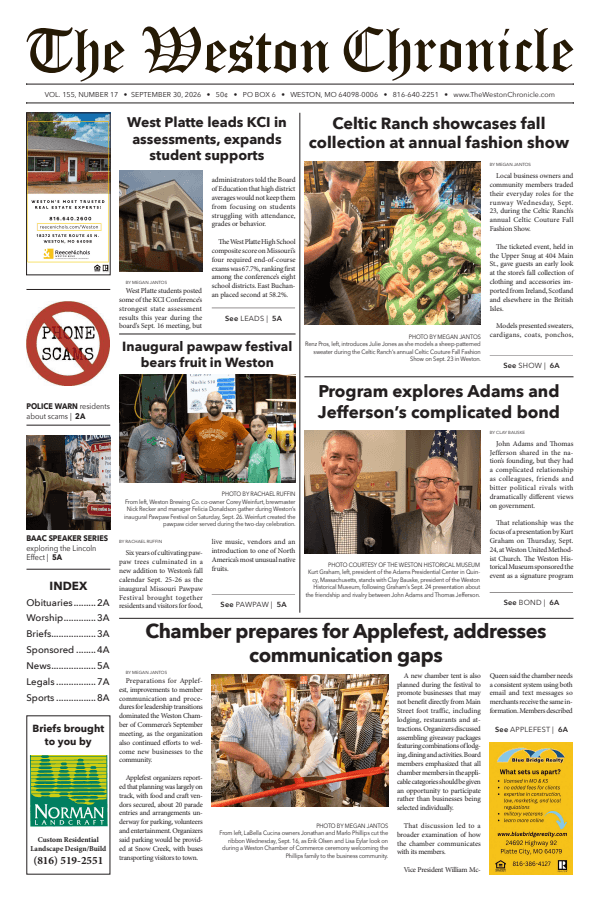
John Adams and Thomas Jefferson shared in the nation’s founding, but they had a complicated relationship as colleagues, friends and bitter political rivals with dramatically different views on government.
That relationship was the focus of a presentation by Kurt Graham on Thursday, Sept. 24, at Weston United Methodist Church. The Weston Historical Museum sponsored the event as a signature program in its yearlong America 250 celebration, offering attendees a detailed look at two of the nation’s founding fathers.
Graham, president of the Adams Presidential Center in Quincy, Massachusetts, traced the relationship between the two men. They first met at the Continental Congress in Philadelphia and served together on the five-member committee charged with drafting the Declaration of Independence in 1776.
Their families developed close ties while Adams and Jefferson served as diplomatic envoys in Europe during and after the Revolutionary War. Under President George Washington, Adams served as vice president and Jefferson served as secretary of state.
As political parties emerged, however, the men’s differing philosophies drove them apart. Jefferson served as Adams’ vice president, but their conflict culminated in the bitter presidential campaign of 1800. Jefferson defeated Adams, setting the country on a different course.
The two had little direct contact after Jefferson took office. In 1812, after both men had retired from public life, they renewed their friendship through correspondence.
“You and I ought not to die before we have explained ourselves to each other,” Adams wrote to Jefferson in 1813.
They continued corresponding for the rest of their lives. Neither man abandoned his political beliefs, but each recognized what they had accomplished together in helping create the nation. Their differences over the presidency became secondary to their shared legacy. Jefferson did not include his presidency among the accomplishments listed in the epitaph he wrote for his tombstone.
In the end, the two founders were joined in death. Both died July 4, 1826 — the 50th anniversary of the adoption of the Declaration of Independence, the document that helped define their shared legacy.