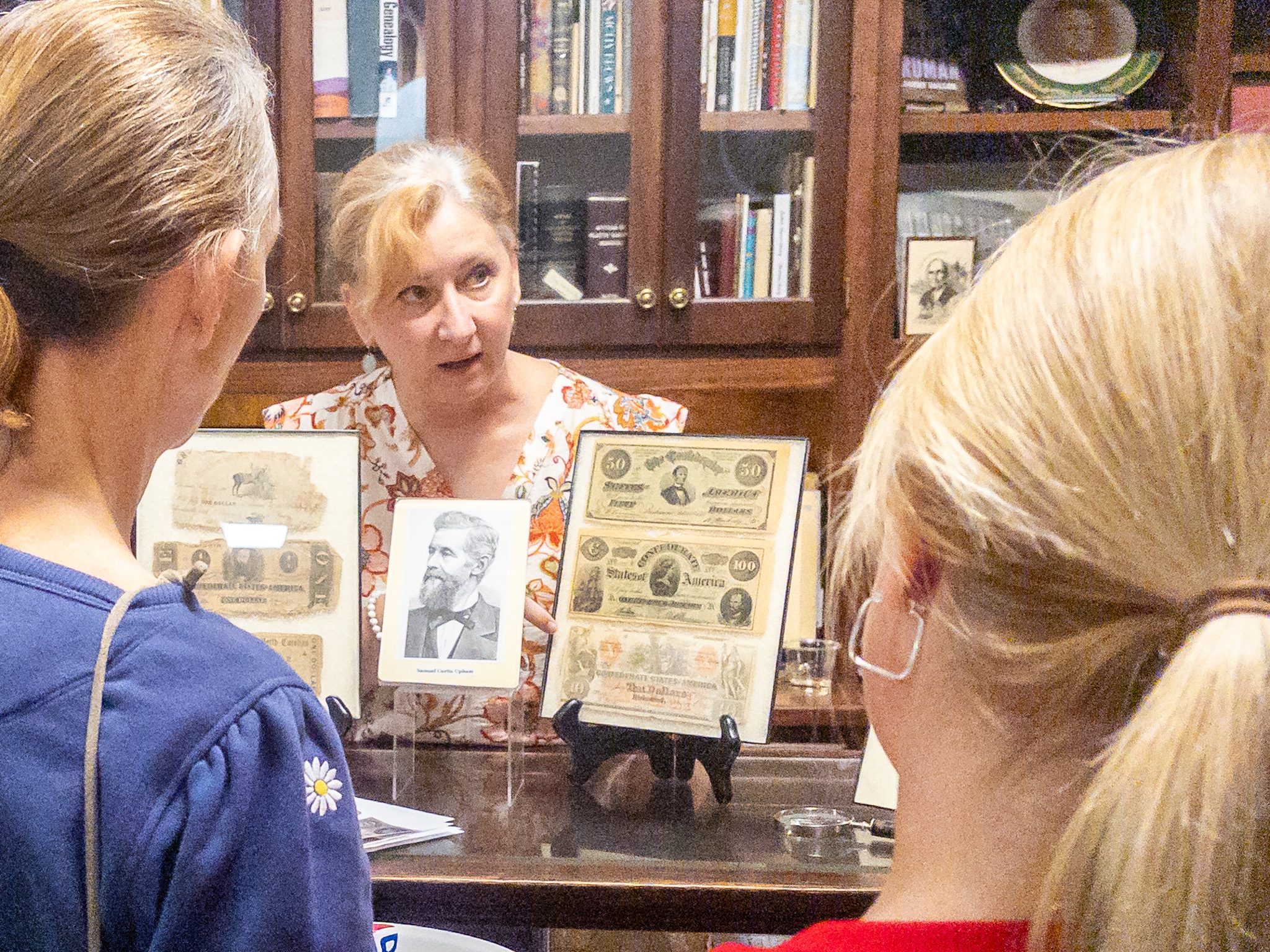
The answer to one of the Weston Historical Museum’s newest mysteries was printed directly on the money: “facsimile.”
That word sent museum curator Shelly Franklin Weinfurt searching for the true history of several Confederate notes in the museum’s collection. The pieces had been identified in the museum’s database as genuine, but several had not been formally accessioned.
“I was getting ready to accession them and started examining them,” Franklin Weinfurt said. “Then I saw it clearly says ‘facsimile’ on the side, and I was like, ‘Wait a minute.’”
She shared the discovery Aug. 20 during History Mystery Hour, the museum’s monthly gathering featuring unusual objects and stories from its collection.
Visitors compared genuine Confederate notes with facsimiles and possible later reproductions. One note plainly reads “Confederate facsimile.” Another has a notice printed along its edge. A third bears serial No. 4398, which Franklin Weinfurt said is commonly associated with reproductions.
The result was what attendees jokingly described as real money, “real fake” money and “fake fake” money.
Some of the facsimiles may resemble those printed during the Civil War by Philadelphia stationer Samuel Curtis Upham. Beginning in 1862, Upham sold reproductions of Confederate notes as souvenirs. The identifying language could be trimmed from the margins, allowing the notes to be passed as currency in the South.
Other reproductions may be much newer. Franklin Weinfurt said replica Confederate bills became popular museum gift-shop souvenirs around the Civil War’s centennial in the 1960s. Some were also distributed as promotional items.
That makes determining whether a facsimile was produced during the war or approximately a century later another part of the mystery.
The museum also has notes Franklin Weinfurt believes are genuine. Unlike the reproductions, the original notes were hand-signed, hand-numbered and cut with scissors from larger printed sheets. She said the signatures were made with ink that faded from black to brown over time.
Because some of the notes are too delicate to handle, Franklin Weinfurt displayed copies during the program.
Most of the Confederate currency came to the museum from the Ohlhausen family, she said. Other pieces were donated by R.J. Felling and a family identified in museum records as Moran.
Franklin Weinfurt said the museum accepted hundreds of objects annually during portions of its history. Although the pieces were processed, they were not always examined as thoroughly as today’s research tools allow.
“Now I have the benefit of the internet to check these things,” she said.
The collection provides a window into a complicated period of Weston’s past, said archaeologist Dr. Ann Raab, whose work focuses largely on the Civil War and the Missouri-Kansas border conflict.
“Weston has a really volatile history related to the Civil War,” Raab said.
The town included both Union and Confederate sympathizers and was affected by slavery, raids and guerrilla warfare along the border, she said. The museum’s currency, firearms and other artifacts help illustrate that divided history.
History Mystery Hour is also intended to make the museum a more familiar and informal gathering place.
“I just wanted to have a party in the museum,” Franklin Weinfurt said. “I want people to get used to being in here.”
Attendee Heidi Sullivan described the museum as a “treasure trove” filled with objects whose stories many residents have never heard.
The next History Mystery Hour is scheduled from 5 to 7 p.m. Sept. 17 at the Weston Historical Museum, 601 Main St. The free program is open to the public, and no reservations or museum membership are required.
The subject, however, will remain a mystery until visitors arrive.