Ninety years ago, a school bus company officially started with a 1936 school district contract. Unofficially, it began in 1934 when Forrest “Frosty” Cassity drove some of his friends to school (for $3 a month) in his six-passenger Model T Touring Car.
Horses were how most students were transported to school before cars. Some schools had sheds to keep the horses in during the school day. Frosty rode his horse to school but turned it loose when he arrived. His horse always made its way home. After school, he would walk four miles home with friends before he had a car.
Two years after graduating from Dearborn High School Frosty approached the school board offering to transport students to school. The board granted him a contract of $75 a month which allowed him to borrow money and outfit his first bus on a 1931 Model A truck chassis.
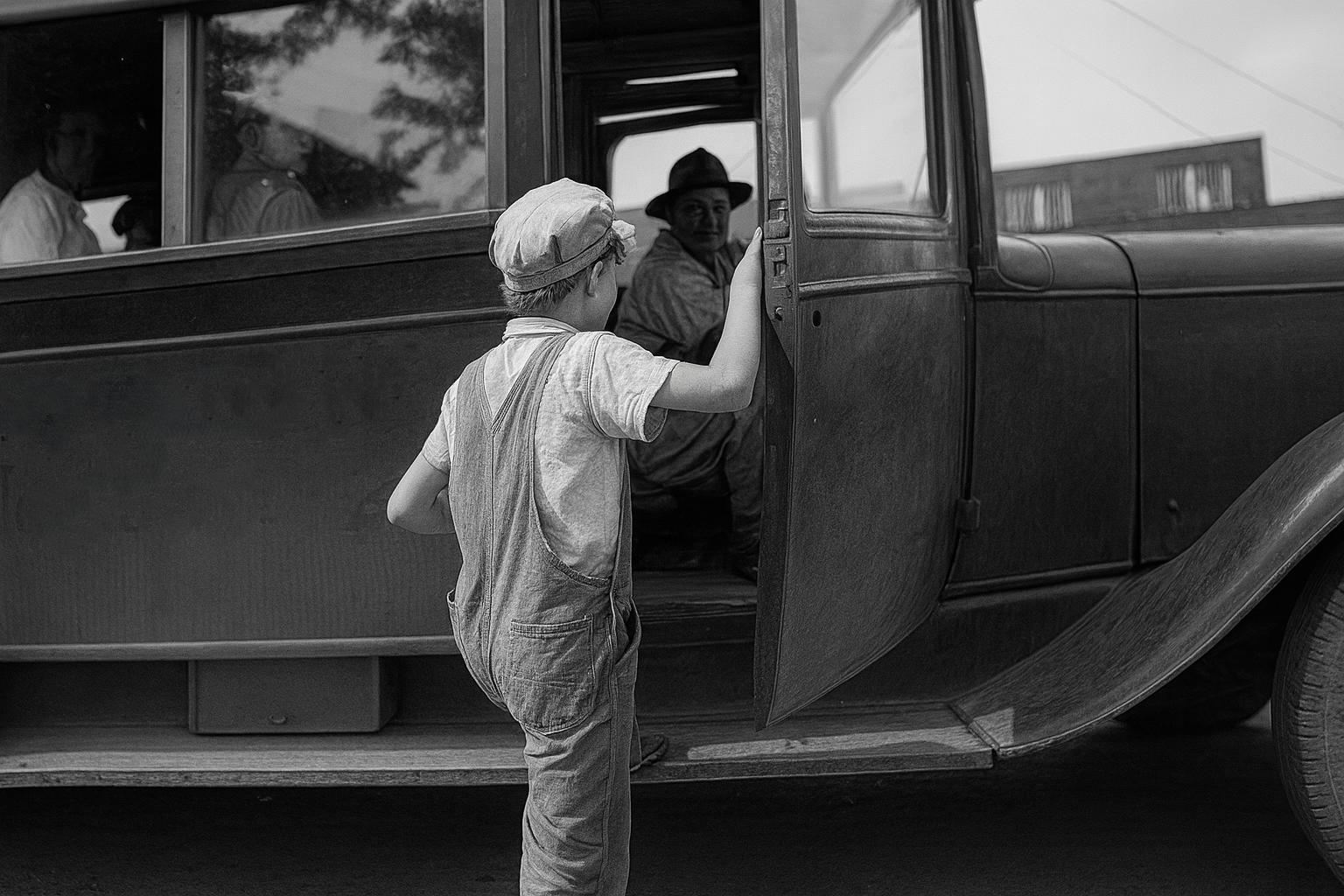
“I remember his first bus,” an early rider recalled years later, “and the experience of having new transportation to school. The bus had benches on either side to sit on, so we sat facing one another; much easier to talk that way. …
Frosty was a good bus driver, dedicated with a pleasant disposition and always courteous. I should know!
There was the day I fell out the door of the bus carrying my violin, hurting nothing but my pride; the next trip he was out of the bus before I was, to make sure I didn’t fall.”
When the district began transporting elementary children, they sat on a bench placed down the middle of Frosty’s bus. Then in 1939 the district required all buses to have forward-facing seats and Frosty bought his first bus to comply with this requirement.
Five years later, Frosty was driving all over Europe with the 8th Armored Division, the 78th Medical Battalion, Company B, as a half-track driver for an ambulance unit.
As an older recruit of WWII, Frosty was called Pops by the teenagers in his unit. Experience won out, however, when the medical unit he was assigned to tried out driver after driver for the half-track that had to run constantly to keep the radio powered up to receive orders of where to pick up wounded soldiers.
The would-be drivers of this all-important half-track couldn’t maneuver the front wheels and the back track together. Disgusted after watching another driver fail, his captain turned to the men and asked Frosty if he thought he could drive it.
Frosty replied that he supposed he could. As he climbed into the driver’s seat his audience had no way of knowing that as a farm boy Frosty had controlled Model T’s trucks, tractors and school buses.
He successfully drove that same half-track through England, France, Holland, Germany and was at the Battle of the Bulge.
Frosty’s wife, Georgia, ran the bus company with the help of a mechanic/driver until Frosty returned home in 1946 to continue farming, drive his bus and start a family which included children, Robert and Jane. Georgia continued to keep the books and write checks for the drivers for decades before turning the bookkeeping over to grandson Jeff Cassity.
In 1951, Dearborn, Camden Point and Edgerton schools were consolidated into the North Platte School District which necessitated more routes and more buses. Eventually, two bus companies carried North Platte students to the junior high and high school at Dearborn and elementary schools at Edgerton and Camden Point.
In 1990 Frosty’s son, Robert, purchased the second bus company and Cassity Bus Company doubled in size running 10-12 bus routes. In 1991 Frosty received the Administrator of the Year Award from the Missouri Association of Public Transportation and he was recognized twice by the school district for his service to North Platte. In the summer of 2007, Frosty received the Distinguished Service Award from the Missouri School Bus Contractors Association.
Frosty died just before the start of the 2007 school year at age 91. Cassity Bus Company continues with his son, Robert, and grandson, Jeff Cassity, maintaining the buses, training drivers; with Jeff occasionally driving a bus as needed.
Frosty saw many changes throughout his tenure as school bus driver and owner of the bus company. In the early years during winter, he put chains on the tires to plow through snow-covered roads to pick up students wearing heavy coats, hats and snow boots. In the 1930s buses cost around $375. Today a bus costs between $90,000 to $150,000.
Improvements in construction of buses have made them one of the safest vehicles on the road. Stop arms, warning lights, radios to communicate with school secretaries and the bus company, and driver requirements, including background checks, continue to aid in protecting the important cargo school buses carry- -our children. (Motorists can help in this endeavor by never passing a stopped bus. That warning arm and flashing lights are on for a reason.)
Frosty modeled his philosophy of transporting school children to his drivers and his grandsons. Both his drivers and grandsons recall that philosophy. “Papa always said a driver needed to be firm, fair, and friendly.”
Frosty began a legacy in 1936 and it continues with today’s Cassity bus drivers. To honor that legacy, grandson John Hagg, Platte City, will be driving one of the big yellow school buses in the Edgerton Pioneer Days parade on Sept. 12 at 9am.